Use Case: AI-Assisted Clinical Documentation · Industry: Hospital & Healthcare · Audience: Physicians, Medical Directors, Software Decision-Makers
The Problem: Documentation That Eats the Time Medicine Needs
Every physician knows the moment. The last patient of the day has been discharged. The ward is quieter. But the work is not done — because the AI discharge letter is not written yet, and neither are the three from yesterday. The discharge summary is one of the most time-critical documents in a hospital: referring physicians need it, follow-up care depends on it, and incomplete or delayed letters create real clinical risk. Yet in most hospitals, it is still written manually, late, and by the most expensive person in the building — the attending physician — often long after the patient has left. Studies in German-speaking countries estimate that physicians spend between 30 and 50 percent of their working time on documentation. That is not a workflow problem. That is a structural problem that directly reduces the time available for patient care, increases physician burnout, and drives staff turnover in a sector already under severe capacity pressure.
Why Standard Tools Fail for Clinical Documentation
1. Speech Recognition Alone Solves the Wrong Problem
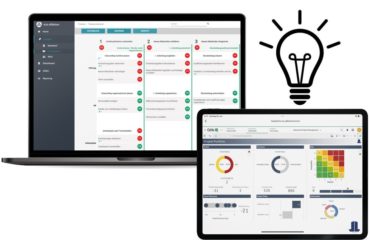
Many hospitals have already invested in speech-to-text software. Physicians dictate, the system transcribes — and then the real work begins: correcting transcription errors, structuring the output, reformatting it to match the required letter template, adding ICD codes, checking drug names and dosages. Speech recognition converts spoken words to text. It does not generate a coherent, structured, clinically accurate discharge letter. The result is a transcript that still requires significant manual post-processing — often by the dictating physician, which negates most of the time savings. As the ad shown above puts it directly: Spracherkennung reicht nicht, wenn Nacharbeit bleibt — speech recognition is not enough when post-processing remains.
2. Generic AI Writing Tools Are Not Built for Medical-Legal Requirements
Off-the-shelf AI writing assistants — including general-purpose large language models — can produce fluent text, but they are not trained on clinical documentation standards, do not integrate with hospital information systems (KIS/HIS), and cannot reliably pull structured data from existing patient records. More critically, they have no awareness of the medico-legal requirements that govern discharge letters in Germany and Austria: the obligation to include specific diagnostic findings, relevant procedures, follow-up instructions, and medication on discharge in a format that meets Bundesärztekammer guidelines. A general AI tool that hallucinates a drug name or omits a secondary diagnosis does not just produce a bad document — it creates liability.
3. No Integration Means Double Data Entry
The fundamental failure mode of most documentation tools introduced into clinical settings is isolation. The tool sits outside the existing hospital information system. Physicians enter patient data into the KIS and then re-enter it — or copy and paste it — into the documentation tool. This is not automation; it is additional work with a different interface. For clinical documentation AI to deliver real time savings, it must read from the systems where patient data already lives: the KIS, the laboratory system, the radiology reports, the medication records. Without bidirectional integration, the tool adds a step rather than removing one.
The LeapLytics Approach: How AI-Assisted Discharge Documentation Actually Works
LeapLytics builds AI systems around a core principle: the AI handles the routine so that the physician focuses on judgment. For discharge letter documentation, that means a structured workflow where the AI does the reading, extracting, and drafting — and the physician reviews, corrects, and signs. Here is how that looks in practice:
- Connect to existing patient data sources. The system integrates with your hospital’s KIS and relevant subsystems — lab results, radiology reports, medication records, procedure documentation. No manual data re-entry. Patient data flows into the AI layer automatically at the point of discharge initiation. The integration is configured once per hospital environment and adapted to the specific system landscape (e.g., Orbis, iMedOne, Nexus, SAP IS-H).
- AI reads and extracts the clinically relevant content. From the connected data sources, the AI identifies and structures the key elements required for a complete discharge letter: primary and secondary diagnoses with ICD codes, relevant procedures and findings, laboratory results outside reference ranges, imaging conclusions, medication on discharge, and follow-up recommendations. This extraction step replaces the most time-consuming part of manual documentation — reading through the full patient record to find what belongs in the letter.
- A structured draft is generated in the hospital’s letter template. The extracted content is assembled into a draft discharge letter that follows the hospital’s own document template — including headers, section order, formatting conventions, and any required legal or administrative fields. The draft is not a generic output; it is pre-formatted for the referring physician and institution, using the language register and level of detail appropriate for the specialty (e.g., internal medicine versus surgical departments).
- The physician reviews, edits, and approves. The draft appears in the physician’s workflow — either within the KIS or in a lightweight review interface — for correction and sign-off. This is the step where clinical judgment is irreplaceable: the physician confirms diagnoses, adds context that was not captured in structured data, and ensures the letter accurately reflects the clinical reality of the case. The AI has done the heavy lifting; the physician provides the expertise and accountability.
- The signed letter is routed automatically. Once approved, the discharge letter is filed in the KIS, sent to the referring physician via the configured output channel (fax, secure email, eArztbrief), and archived. No manual export, no printing-and-scanning loop, no letter sitting in an outbox waiting for someone to process it. The LeapLytics AI platform handles the routing based on pre-configured rules for each department and document type.
- The system learns from corrections over time. Edits made by physicians during the review step feed back into the model. If a particular department consistently restructures a specific section, or a specialty team uses different terminology, the system adapts. Over weeks and months, the draft quality improves to the point where the review step becomes genuinely fast — not because physicians are skipping it, but because there is less to correct.
What Changes in the Physician’s Day-to-Day
The most immediate change is time. Hospitals that have implemented AI-assisted discharge documentation consistently report that letter preparation time drops from an average of 20–40 minutes per patient to 5–10 minutes for review and sign-off. For a ward physician responsible for 8–12 discharges per week, that is several hours of reclaimed time — time that shifts back to patient contact, ward rounds, and clinical decision-making.
The second change is timing. Discharge letters that previously sat incomplete for 48–72 hours after patient discharge — because no physician had time to write them — are now available within hours. Referring physicians receive complete, accurate documentation faster. Follow-up appointments are scheduled with the correct information. Medication handovers are safer because the discharge medication list is accurate and timely.
The third change is less visible but equally important: physician burnout from administrative overload decreases. Documentation burden is one of the most consistently cited drivers of physician dissatisfaction and attrition in German hospitals. Removing the end-of-day stack of unwritten letters does not just save time — it changes the emotional texture of the workday. According to the Deutsches Ärzteblatt, documentation burden is now among the top three reasons physicians cite for considering a career change. Reducing it has a measurable impact on retention.
For software decision-makers and medical directors evaluating AI tools for clinical documentation, the relevant outcome metrics are straightforward: average time from patient discharge to letter completion, physician time spent on documentation per shift, letter completeness rates on first draft, and follow-up query rates from referring physicians. All of these are measurable before and after implementation — which makes the business case for medical letter AI software unusually concrete compared to many digital health investments.
FAQ: Common Questions from Hospital Decision-Makers
How does the system handle data protection and patient privacy under GDPR and German hospital law?
All patient data is processed within the hospital’s own infrastructure or in a GDPR-compliant, German-hosted cloud environment — no patient data is sent to external AI providers or used for model training outside the hospital’s control. The system operates on a data processing agreement (Auftragsverarbeitungsvertrag) compliant with DSGVO Article 28, and access is controlled via existing hospital role and rights management. LeapLytics works with each hospital’s data protection officer during implementation to ensure full compliance with the applicable legal framework, including the relevant state hospital laws (Landeskrankenhausgesetze).
What happens if the AI draft contains an error — who is liable?
The physician who reviews and signs the discharge letter carries the same clinical and legal responsibility as they do today. The AI produces a draft; the physician approves a document. This is structurally identical to a junior physician or medical secretary preparing a draft for consultant review — a workflow already well-established in German clinical practice. The system is explicitly designed to keep the physician in the loop as the accountable party, not to bypass clinical judgment. Implementation includes a mandatory review step that cannot be skipped, and the system logs all edits and approvals with timestamps for audit purposes.
How long does implementation take, and does it require a large IT project?
For hospitals with a standard KIS environment (Orbis, iMedOne, or similar), a pilot implementation covering one or two departments typically takes 6–10 weeks from kickoff to live operation. The majority of that time is spent on KIS integration configuration and testing, not on the AI layer itself. A full hospital-wide rollout following a successful pilot is typically achievable within a further 3–6 months. LeapLytics manages the integration work; the hospital’s IT department is involved for access provisioning and system configuration, but does not need to build or maintain the AI infrastructure. See the LeapLytics AI solutions overview for more detail on the implementation approach.